
Milk is a highly nutrient-dense substance and requires a significant amount of quality feed to be consumed by the cow to produce enough of it to satisfy the demands of a growing calf. During lactation it is common for cows to lose condition as they partition almost all their consumed nutrition towards milk production. This is what you need to keep in mind when looking to wean cattle this season.
Key Points
-
Weaner growth and development is arguably the most important point of weaning.
-
The condition of the cow is the best indicator for when it is time to wean.
-
It is more efficient to wean and feed weaners and cows separately than together.
-
Effective weaning can boost the productive capacity of weaner’s throughout their lives.
Despite having a calf weaning weight benchmark in mind, the condition of the cow will be the best indicator of when to wean. If cows have been “milking off their backs” for an extended period, early weaning should be considered to get the calves off and get cows back into condition for the next pregnancy cycle.
Note: In losing 1kg of liveweight a cow will free up 28MJ ME. However, to put that 1kg of liveweight back on it will cost 42MJ ME. Don’t let your cows lose too much weight before weaning.
As dry seasonal conditions bite and the quality and quantity of feed declines, the most efficient production may be generated from early weaning, as opposed to supplementary feeding of cows at current fodder costs.
Irrespective of when you decide to wean, continuing the growth and development of calves during the weaning process is of the utmost importance, as this period can determine the body composition and productive capacity of weaners throughout their lives.
A weaner diet for a 200kg calf should aim to put on around 1kg/hd/day in liveweight gain. Therefore, it will require a diet consisting of 80JM ME and 16% CP.
Feed conversion in calves, on good quality fodder, is also very efficient, so money spent on good feed during weaning will likely generate the greatest return throughout the weaner’s life.
Dr Paul Meggison’s tips to assist with a successful and stress-free yard weaning
- Imprint feed the calves at least three times prior to weaning to introduce them to a new feed.
- Creep feeding a pellet or grain mix is good practice – talk to ANP for suggested diet specs and formulations. Grain accelerates rumen development, leading to greater utilisation of forage throughout the animal’s life.
- Wean animals in appropriate conditions. Pick a mild day when it’s not raining and the maximum temperature is less than 30 degrees. This can be difficult during hot summers. If unavoidable, wean early in the morning, or late in the afternoon, to minimise heat stress.
- Group animals into weight classes if possible.
- Provide access to clean fresh water and a diet of ad lib high quality hay or silage, some straw for extra roughage and an increasing diet of a simple grain mix or pellets.
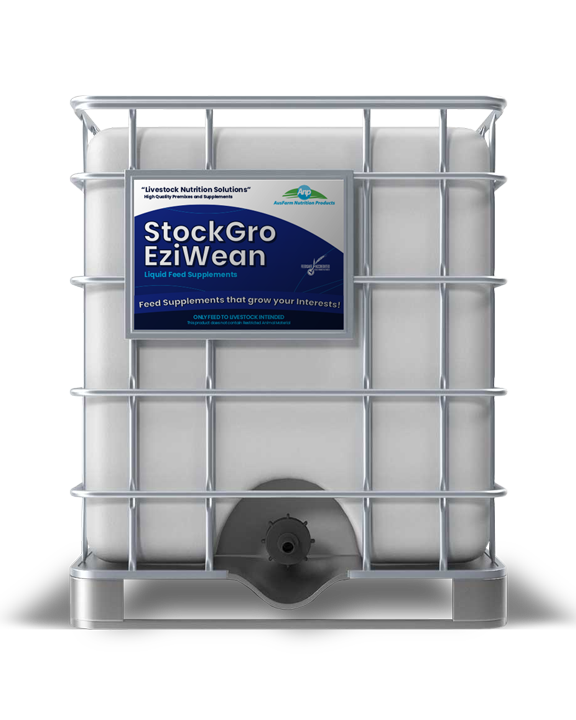
- Ensure that essential mineral, vitamin and trace element requirements are being met, specifically calcium, sodium, vitamin A, vitamin E and trace elements. These need to be supplemented as the calves are no longer receiving adequate levels when no longer drinking milk. StockGro-EziWean is a great supplement for filling this void during weaning.
- Fly management is important in reducing the incidence of pinkeye. Talk to us about feed supplements that have been shown to reduce fly pressure in cattle.
StockGro-EziWean is an effective liquid feed supplement, specifically designed to satisfy mineral, vitamin and trace element requirements, reduce cow and calf stress and support rumen development, allowing weaners to retain weight and transition onto new diets quickly.
StockGro-EziWean is now available with FlyBye to aid in reducing fly pressure on cattle during weaning.